
Dietary fiber in grains reduces the risk of developing diabetes.
Bonn, November 14, 2012 – The positive effects of dietary fiber in grains on diabetes prevention were the central theme of the 5th Scientific Symposium of the German Milling Association. The latest scientific findings were presented last Friday in Würzburg. Today, World Diabetes Day draws attention to this widespread metabolic disease.
“Currently, 366 million people worldwide are affected by diabetes,” stated Caroline Honig, a research associate at the German Institute of Human Nutrition (DIfE), “and according to current estimates, this number will reach approximately 552 million by 2030.” In Germany, too, type 2 diabetes is among the most common and costly chronic diseases, particularly affecting people in the second half of their lives. According to Honig, this makes diabetes prevention all the more important, and it is a topic of research at the DIfE in the Department of Clinical Nutrition, headed by Prof. Dr. Andreas Pfeiffer.
„Recent studies confirm that a high consumption of dietary fiber from grains and grain products is associated with a reduced risk of diabetes,“ emphasized Honig. In particular, the insoluble fiber in grains improves glucose metabolism in people with diabetes mellitus or prediabetes.
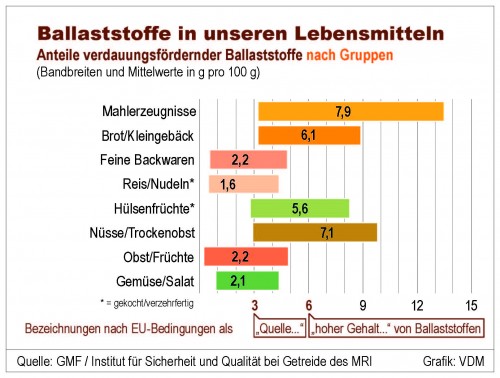
The intake of dietary fiber in the German population is significantly below the 30 grams per day recommended by the German Nutrition Society (DGE). Both women and men have an average „supply gap“ of around 20 percent, as determined by the National Nutrition Survey conducted by the Max Rubner Institute. Consuming grains, flour, and baked goods, by far the most important sources of dietary fiber for Germans, can be a particularly effective remedy.
The German Milling Association hosts its annual Scientific Symposium in Würzburg. There, scientists and representatives of the milling industry discuss topics of importance to the sector, particularly those related to nutrition. This established event not only fosters dialogue between the milling industry and academia but also provides a forum for young scientists to present their work.
Tip: A table “Dietary fiber in our food” with 140 entries is available for download on the internet.
From field to plate: Mills and flour are a central part of the food chain. 550 German mills grind around eight million tons of wheat and rye every year. Their milled products – flour, grits, bran, and whole-grain products – form the basis for the unparalleled variety of bread and baked goods in Germany. With approximately 6,000 employees, the mills generate annual sales of nearly 2.5 billion euros. The German Milling Association, headquartered in Bonn with an office in Berlin, represents their interests.
Contact:
German Milling Association (Verband Deutscher Mühlen eV)
, Lena Salein, M.Sc. Nutrition,
Phone: +49 228 97610-15,
Email: vdm@muehlen.org,
Website: www.muehlen.org ; www.mein-mehl.de





Hinterlassen Sie einen Kommentar